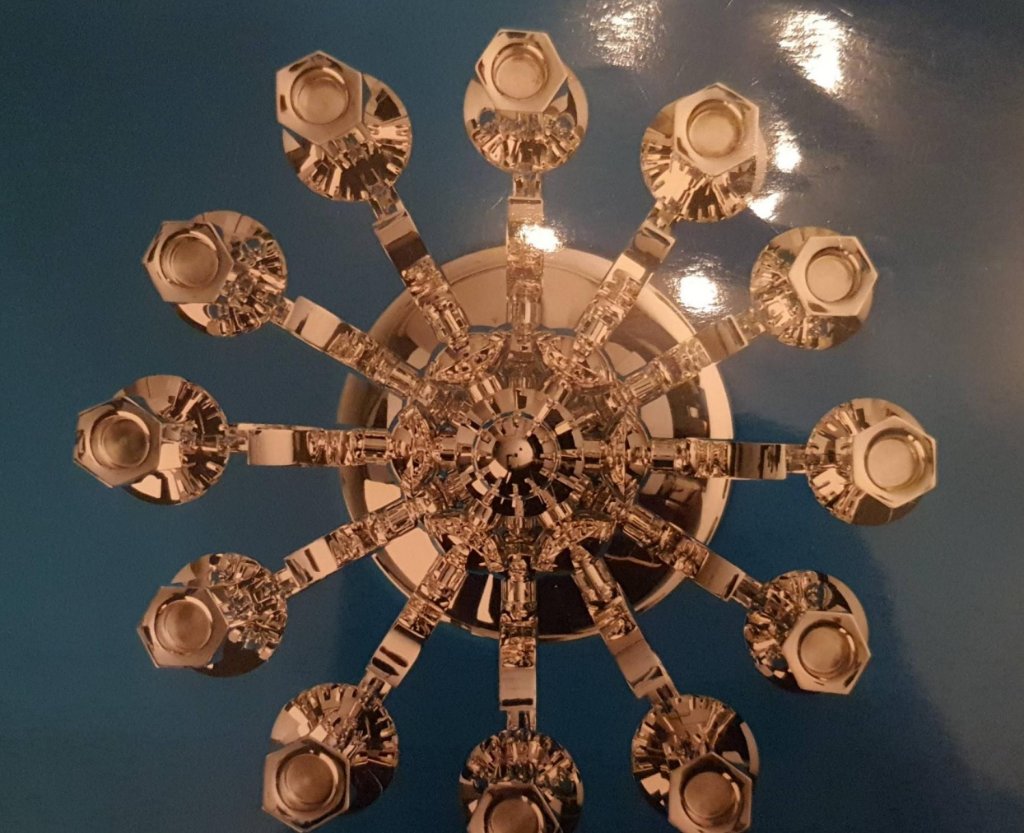
"I don't sell tomatoes in the market; you are buying art here." — When the Weight of Silver Meets the Weight of Art
Discover how master silversmith Carmel Shabi defended the soul of craftsmanship against the strict metrics of the silver market, refusing to let his heavy, architectural creations be weighed like common produce.
There are moments from my father's studio, the late Carmel Shabi, that remain etched in my memory — not because of the rhythmic strike of the hammer or the distinct scent of soldering, but because of his words.
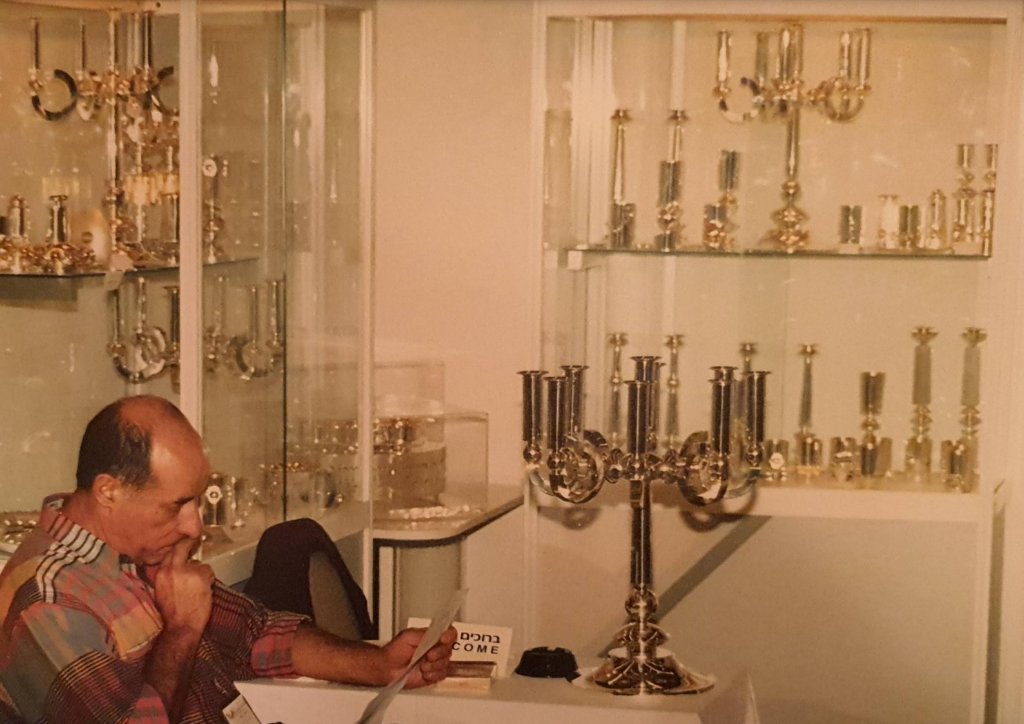
Anyone familiar with his exhibition routine surely remembers the setting: the traditional biennial Judaica exhibition at the International Conventions Center (Binyanei HaUma) in Jerusalem. The halls were flooded with light, crowds flowed between the booths, and my father stood proudly behind his gleaming silverware. Yet, alongside the celebration, there was a recurring ritual: every few minutes, a visitor would approach, lift a goblet or a menorah, weigh it in their hands, and ask the one question my father detested most:
"How much does this piece weigh?"
After the tenth or twentieth time that day, my father would look at the visitor with a half-amused, half-protesting smile, and deliver the response that became his trademark:
"I don't sell tomatoes in the market; you are buying art here."
The Weight Between Matter and Spirit
In the field of silversmithing and Judaica, it is customary to evaluate silverware by its weight in grams. People looked for a "secure value" — how much raw material they were getting for their money. But for my father, this approach completely missed the essence of creation.
To Carmel Shabi, silver was not just a precious metal; it was a canvas. When someone insisted on weighing a kiddush cup or a spice box, they overlooked the countless hours of conceptualization, the precision of the structural design, the years of refining his technique, and the soul breathed into cold metal to transform it into a living ceremonial object.
"If you want weight, buy silver bullion," he would sometimes tell a persistent customer. "If you buy a piece of mine, you are buying its story, its design, and my time."
The Painter's Analogy and the Silver Trap
Would anyone dream of approaching a painter and asking how much the tubes of oil paint or the stretched fabric cost? Of course not. We intuitively understand that the value of a painting lies in the artwork itself — in the artist's spirit, not in the raw materials.
Yet silversmithing holds a unique paradox: unlike paint pigment, silver is a precious metal. Its prices fluctuate constantly, it is traded on the stock exchange, and it is a tangible financial asset. It is natural for a buyer to ask how much "hedging value" they hold in their hands.
But my father's reply — "I don't sell tomatoes" — came precisely to rescue the artwork from this financial trap. He understood that if we evaluate a piece of Judaica solely by that morning's bullion price, we reduce a work of art to an anonymous silver bar. The hours spent mastering hollow-ware techniques, the complexity of modular structures, and the absolute geometric precision would all become worth zero. His goal was to endow an already precious material with a value that transcends any stock market fluctuation: the value of culture and eternity.
A Dialogue with Metal
The irony is that anyone familiar with my father's work knew his pieces were characterised by magnificent presence and physical weight — he insisted on exceptionally thick silver sheets, making his vessels durable, substantial, and commanding. Yet they never conveyed coarseness or clumsiness. On the contrary: they possessed a clean nobility, a formal lightness, and an extraordinary refinement. The material always served the composition, the architectural angles, and the play with negative space — never the price per kilogram.
His refusal to be measured in "grams of silver," voiced time and again before hundreds of visitors in Jerusalem, was ultimately his stand for the dignity of the craft and of traditional, handmade artistry.
A Legacy of Value, Not Price
Today, as I look at the works he left behind and manage his archive, this phrase resonates within me even more deeply. In a world where everything is too often measured in numbers and quantitative metrics, my father left us a profound lesson on what truly holds value: art, spirit, and the ability to transform a block of metal into an object that touches eternity.
The next time you look at a piece of silverware or a work of art, do not ask how much it weighs. Ask what thoughts it awakens in you, and how much soul was poured into it. Because at the end of the day — you buy tomatoes at the market. But in the studio, you buy life.
Stories & Updates
Newsletter
A Craft That Continues to Illuminate Hearts
Join our monthly newsletter and receive in-depth stories, behind-the-scenes sketches, and exclusive glimpses into the archive of Carmel Shabi's works.
Memories & Reflections
Share a Memory of Carmel
Related Stories